
From Missile Strikes to Market Rallies: 5 Counter-Intuitive Truths About Our New Economic Reality
1. Introduction: The Whiplash Economy
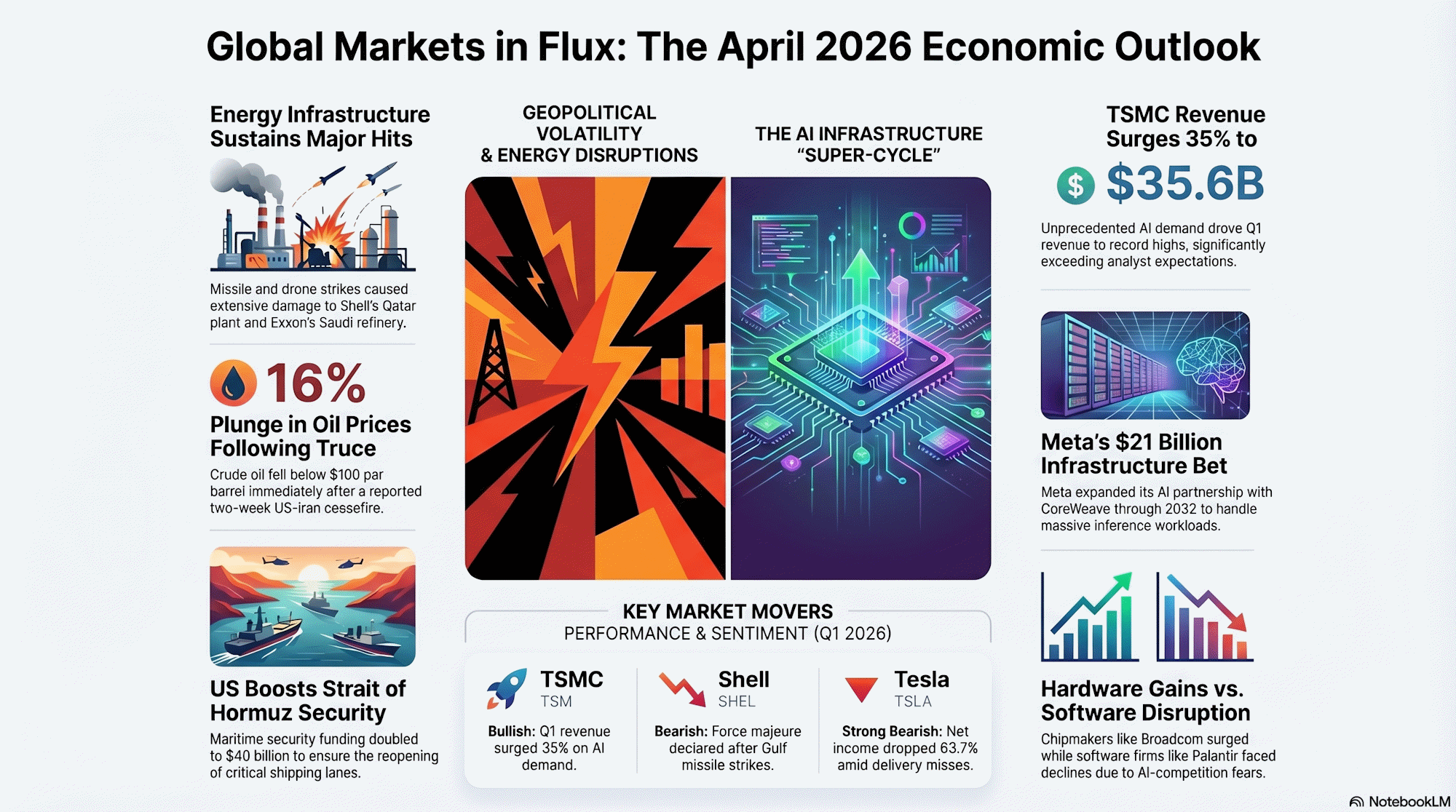
The opening week of April 2026 offered a jarring masterclass in the "Whiplash Economy." On the ground, the physical world seemed to be fracturing: drone and missile strikes tore through Shell's gas-to-liquids plant in Ras Laffan and Exxon Mobil's Samref refinery, triggering force majeure declarations and disrupting the global energy spine. Yet, in the digital cathedrals of lower Manhattan, equity markets staged a defiant decoupling from this physical chaos. Stock futures didn't just stabilize; they ignited a sharp rally that saw the S&P 500 post its most significant weekly advance since November. This paradox-where structural damage to energy infrastructure coexists with record-breaking market gains-reveals a new economic reality where sentiment-driven diplomacy and the insatiable "compute-resource land grab" now outweigh the traditional gravity of geopolitical risk.
2. The Ceasefire Catalyst: Why a "Two-Week Truce" Reset the Global Ticker
The catalyst for this sudden evaporation of the geopolitical risk premium was the announcement of a workable 10-point proposal from Tehran, culminating in a two-week ceasefire agreement. This temporary diplomatic breather acted as a vital sentiment floor, providing the liquidity-driven relief rally that the broader market desperately craved.
The impact was immediate and mathematical. Oil prices, which had been threatening to spiral toward a permanent crisis at \$117 per barrel, plummeted back below the \$100 threshold. With the energy tax on the global economy momentarily eased, the S&P 500 surged 3.9% for the week, while the Nasdaq 100 jumped over 3%. This pivot illustrates a profound fragility: the market is currently willing to overlook the actual charred remains of refineries in favor of the hope of a diplomatic off-ramp.
Sentiment Trends: Despite immediate concerns regarding infrastructure damage and shipping disruptions in the Strait of Hormuz, US stock futures (S&P 500 +2.60%, Nasdaq 100 +3.30%) surged following the reported US-Iran truce, effectively overriding physical supply chain fears with a wave of "peace talk" optimism.
3. The \$30 Billion Run Rate: AI Infrastructure is Decoupling from the Software Slump
The tech sector is currently undergoing a violent internal schism. We are witnessing a clear divergence between the "picks and shovels" of the AI era-chips and data centers-and the software layer that was supposed to utilize them.
The Infrastructure Land Grab The demand for compute has reached a fever pitch. Anthropic's revenue run rate has exploded from \$9 billion to over \$30 billion, bolstered by deep-pocketed alliances with Google and Broadcom. Meta has doubled down on its digital architecture, expanding its deal with CoreWeave to a staggering \$21 billion through 2032. Broadcom, now a cornerstone of this new economy, projects that its custom AI chip sales will breach the \$100 billion mark by 2027.
The Software/Security Friction Conversely, the "software layer" is under siege. Palantir's stock hemorrhaged 17% over four days, but the driver wasn't just competition-it was a crisis of trust. US officials recently issued stark warnings to banks regarding "Claude Mythos," Anthropic's newest model, citing acute cybersecurity risks. This "macro-risk" is forcing a pivot toward initiatives like Project Glasswing, a cybersecurity collaboration involving Microsoft and Anthropic, proving that while code is under pressure, the infrastructure required to secure that code remains the primary value capture.
4. The Human Cost of Efficiency: AI's Quiet Displacement of Gen Z
While the "Terafab" era creates billions in enterprise value, it is simultaneously dismantling the entry-level labor market. The most proficient users of AI are, ironically, becoming its first casualties.
Labor Market Statistics: Goldman Sachs estimates that AI is now responsible for a net displacement of 16,000 US jobs every month. This trend is "disproportionately affecting Gen Z," creating a generational friction where technical fluency no longer serves as a defensive moat.
This displacement is happening in the shadow of record investment. While Anthropic aggressively scales its compute capacity, The Walt Disney Company has cut 1,000 marketing roles to maximize efficiency. We are seeing a pattern across Meta, Oracle, and Qualcomm: massive capital expenditure on AI infrastructure paired with surgical layoffs. The data suggests that AI isn't just a tool for the worker; in many sectors, it is a direct replacement for the youngest cohort of the desk-based workforce.
5. The "Terafab" Era: When Rivalries Fade for the Sake of Compute Power
The desperation for hardware has reached such a state that traditional corporate silos are being dismantled. The "compute-resource land grab" has forced former enemies into a pragmatic, and perhaps uncomfortable, embrace.
Nowhere is this more evident than in the partnership between Intel and Elon Musk's Terafab project. To achieve Terafab's goal of producing one terawatt of compute power annually, Intel is integrating its Xeon processors into a "dual-architecture" hardware strategy that involves working alongside its chief rival, NVIDIA. This is the rise of "sovereign compute strategies": Intel is opening its Foundry segment to giants like Google and Meta, recognizing that in the race to power humanoid robots and global AI, the ability to manufacture at scale is more valuable than maintaining a closed ecosystem.
6. The Resilience of Healthcare: Why Policy Wins Outperform Geopolitical Chaos
While the headlines were dominated by missile strikes in the Gulf, the healthcare sector found a more durable source of growth: regulatory certainty. While the broader market was whipped by "risk-on/risk-off" geopolitical trades, healthcare giants like UnitedHealth Group (UNH), Humana (HUM), and CVS Health posted significant gains.
The driver was a domestic policy shift from the Centers for Medicare & Medicaid Services (CMS), which announced a 2.48% net average increase in Medicare Advantage payment rates for 2027. This translates to a \$13 billion capital injection into the private sector. It is a reminder for the macro-strategist that while "fragile diplomacy" provides temporary market rallies, "regulatory certainty" in domestic policy provides the underlying floor for long-term value.
7. Conclusion: The \$40 Billion Question
The volatility of April 2026 reveals an economy that is growing vertically through AI but remains horizontally vulnerable through energy. The US decision to double its Strait of Hormuz security funding to \$40 billion is a tacit admission that the physical backbone of our economy is under permanent threat.
As we navigate this rally, we must weigh the bullishness of the "Terafab" era against the sobering warnings of JP Morgan's Jamie Dimon. Dimon has cautioned that the global economy remains dangerously unprepared for the "cockroaches" that invariably emerge from interest rate volatility and the private credit sector during times of geopolitical strain.
The rapid decoupling of AI hardware from software suggests that the market now values the raw capacity to compute-and the physical infrastructure to protect it-far more than the code it runs.
Not investment advice. Independently verify information and assumptions.