
From the AI Gold Rush to the Oil Shock: 5 Trends That Will Flip Our World Upside Down in 2026
Listen up, because what I'm about to tell you is wild.
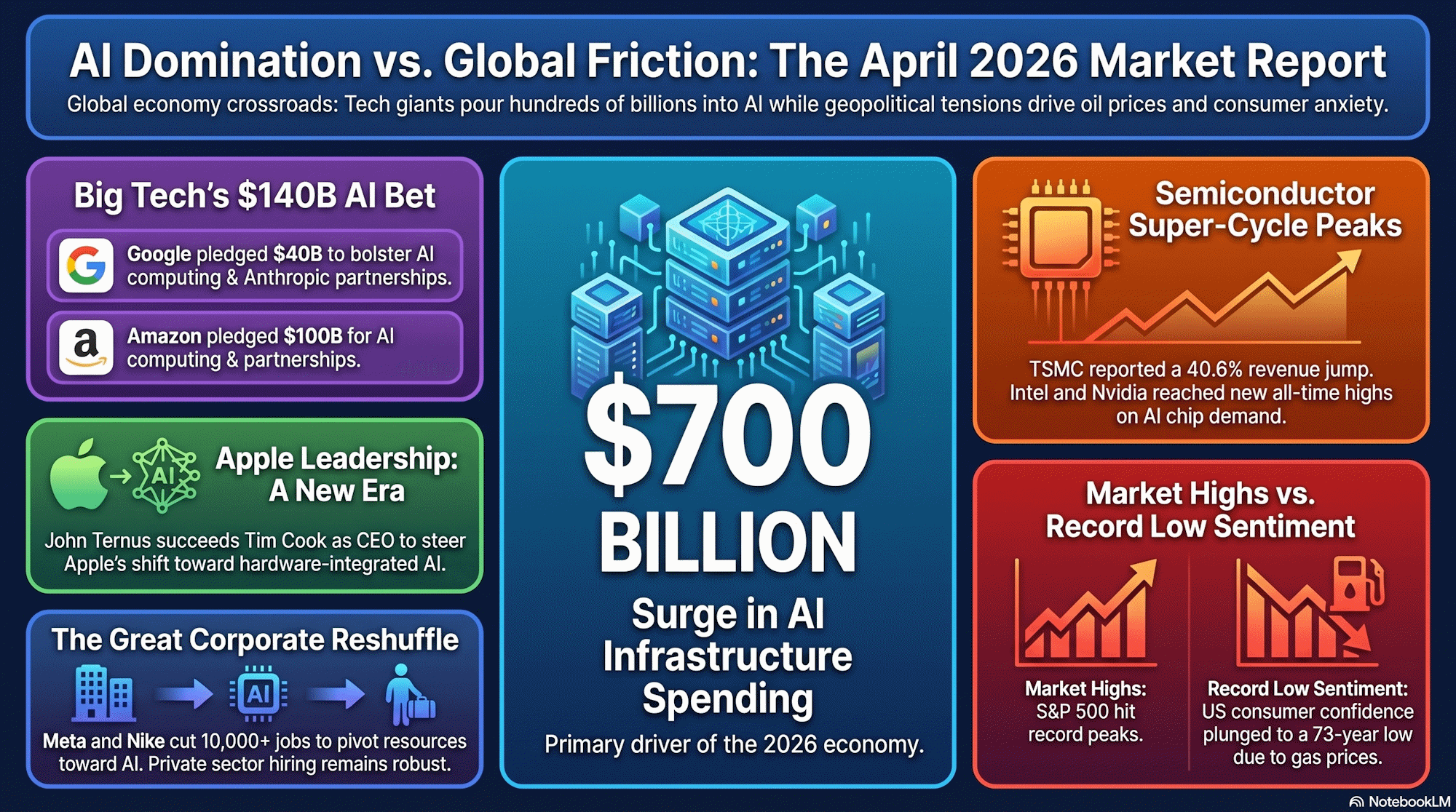
It's April 2026, and the global economy? It's one giant contradiction right now. On one side: The markets are partying. S&P 500, Nasdaq — everything is ripping from one all-time high to the next. Why? Because Artificial Intelligence is dominating everything. But hold on tight: At the same time, US consumer confidence has crashed to 49.8 points. My friend, that's the worst reading in 73 years. Let that sink in for a second.
So what's going on here? Simple: The algos are pushing stocks into the stratosphere, but the average Joe is crying at the gas pump. Digital dreams vs. real-world fears — they're colliding right now with full force. And the big question we as investors have to ask ourselves: How long can this glittering tech facade keep outshining geopolitical reality?
Let's dive in. Here are the 5 trends you need to have on your radar right now.
1. The 40-Billion-Dollar Bet: Big Tech Goes All-In on AI
Boom! The AI experiment is over, my friend. Now we're playing for keeps.
Google? Just cranked up its bet on Anthropic to a mind-blowing 40 billion dollars — 10 billion of that on the table immediately. Amazon is right behind, deepening its partnership with the same AI player and locking in AWS cloud deals worth 100 billion. Listen carefully: This isn't about cute software features anymore. This is about controlling the global infrastructure.
And in this game, hardware calls the shots. Meta is doing a 180 and stuffing tens of millions of Amazon Graviton cores into its data centers — efficiency up, dependence on a single supplier down. Smart move. And Intel? Buddy, Intel is back. The new Terafab facility is running the 14A process and producing chips for Tesla and SpaceX. Mobility meets high-performance computing. We've never seen anything like this.
But the gravitational center of this whole universe stays — you guessed it — Nvidia. 5 trillion dollars in market cap. And the new Vera Rubin architecture, built for Agentic AI, is rewriting the rule book as we speak.
And here's the kicker: Market watchers see Nvidia hitting 20 trillion dollars by 2030. Twenty. Trillion. If AI inference becomes the most valuable commodity in the economy, then Jensen Huang is sitting on the throne of the world economy.
2. The Bitter Truth: Layoffs Despite Record Profits
Now it gets uncomfortable. Because behind those shiny earnings reports, something completely insane is going down.
The tech giants are firing people. By the thousands. While at the same time pumping in record investments. Sounds paradoxical? It is.
Meta? 8,000 jobs gone. That's roughly 10% of the workforce. Why? To free up capital for the AI offensive. Microsoft is doing the same thing, offering 7% of its employees "voluntary" severance packages. You know exactly what "voluntary" means in this context.
And it doesn't stop with the tech crowd. Nike is cutting 1,400 jobs to centralize technological functions and slim down for the AI era. My friend, this is the new reality: People aren't getting kicked out because of crises anymore — they're getting kicked out by the cold, brutal reallocation of capital into automated intelligence.
Write this down: Scaling now runs through technology, not headcount. Period.
3. Game Over for Cheap Imports: China Flips the Script
Pay attention, because this is huge.
For decades, China was our disinflation angel. The factory of the world. Cheaper was always possible. But in 2026? Done. Game Over.
Chinese exporters are now noticeably raising their prices. And just like that, the global disinflation trend flips into reverse. Why are they doing this? Because internal pressure is mounting. Youth unemployment in China climbed to 7.7% in March — and the AI expansion is killing entry-level jobs faster than new ones can pop up.
What does that mean for you? My friend, this is dangerous. When the factory of the world gets more expensive AND energy prices simultaneously go through the roof, inflation forecasts blow up in our faces. The era of cheap imports — the era that financed Western prosperity for decades — is coming to an end.
Central banks and consumers need to rethink. Painfully. And right now.
4. Apple Without Tim Cook: The Changing of the Guard
September 1, 2026. Mark that date down. Because that's the day Apple makes maybe the most important move in its recent history.
Tim Cook is stepping back. He's moving into the role of Executive Chairman and handing the reins over to John Ternus. The markets? Are reading this as a signal of continuity for now. But let me tell you something: For Ternus, this is going to be a tightrope walk.
Why? Because Apple has to take the design DNA that Steve Jobs and Cook built and carry it into a completely new world — a world driven by Agentic AI and constant hardware innovation. The competition is loading up massively on AI chips and specialized hardware. Apple has to prove it can do more than just build smartphones.
The big question is: Can Apple make the leap from smartphone pioneer to leading player in a world where your personal AI assistant becomes the primary interface to the internet? The slight nervousness in the markets shows: Investors want to see proof first. Fair enough.
5. The Achilles' Heel of the Global Economy: Strait of Hormuz
And now to the trend that personally gives me the most heartburn.
For all the digital euphoria — the global economy remains a hostage of geography. Tensions in the Strait of Hormuz have driven Brent crude up to 120 dollars a barrel. One hundred and twenty dollars! You feel it at the gas pump, you feel it in heating oil, you feel it in EVERY single product that needs to be transported.
Senator JD Vance and US envoys had to fly to Pakistan at the last minute to mediate diplomatically. Listen up: They literally just prevented a global economic collapse.
And here's the crazy part: The US has a digital trade surplus of 282 billion dollars. Sounds fat, right? But all that technological wealth doesn't protect you from blocked sea routes and exploding energy costs.
My friend, geopolitical risk in 2026 is no longer a "black swan." It's a priced-in but still highly unpredictable constant. We have to live with it. The markets have to live with it.
My Take: Are We Staring Into the Abyss — or Into the Future?
Alright, let's talk straight.
2026 is the year of the great synthesis — and the year of great risk. We've built a digital economy that's richer and more innovative than anything humanity has ever seen. But it stands on a foundation that's wobbling because of physical instability and massive social upheaval.
AI growth and geopolitical fragility? Two sides of the same coin. You cannot separate them.
And now the question you have to ask yourself: Are you ready for a world where unchecked AI growth and geopolitical instability are the new, inseparable constants of our economy?
Drop your take in the comments. I want to hear what you think.
Until then — stay smart, stay invested.
Not investment advice. Independently verify information and assumptions.