
Why 2026 Will Be the Most Important Semiconductor Year of Your Life – And Most People Are Sleeping Through It
Picture this for a moment: It's the early 2000s. You walk into an electronics store, browsing the latest mobile phones, when one of the salespeople leans over and whispers, "In ten years, a company from Cupertino that almost went bankrupt will be the most valuable corporation on the planet." You'd have laughed in his face. You probably would have bought yourself a Nokia share instead.
We're having exactly that moment again right now. Only this time, it isn't about smartphones. It's about semiconductors. And here's the kicker: The data is sitting right there on the table. Out in the open. And most people are still looking the other way.
Let me show you the raw numbers
The global semiconductor market sat at around 627 billion dollars in 2024. By 2030, it's projected to break through the trillion-dollar barrier. Sounds like nice, steady growth, right? Wrong.
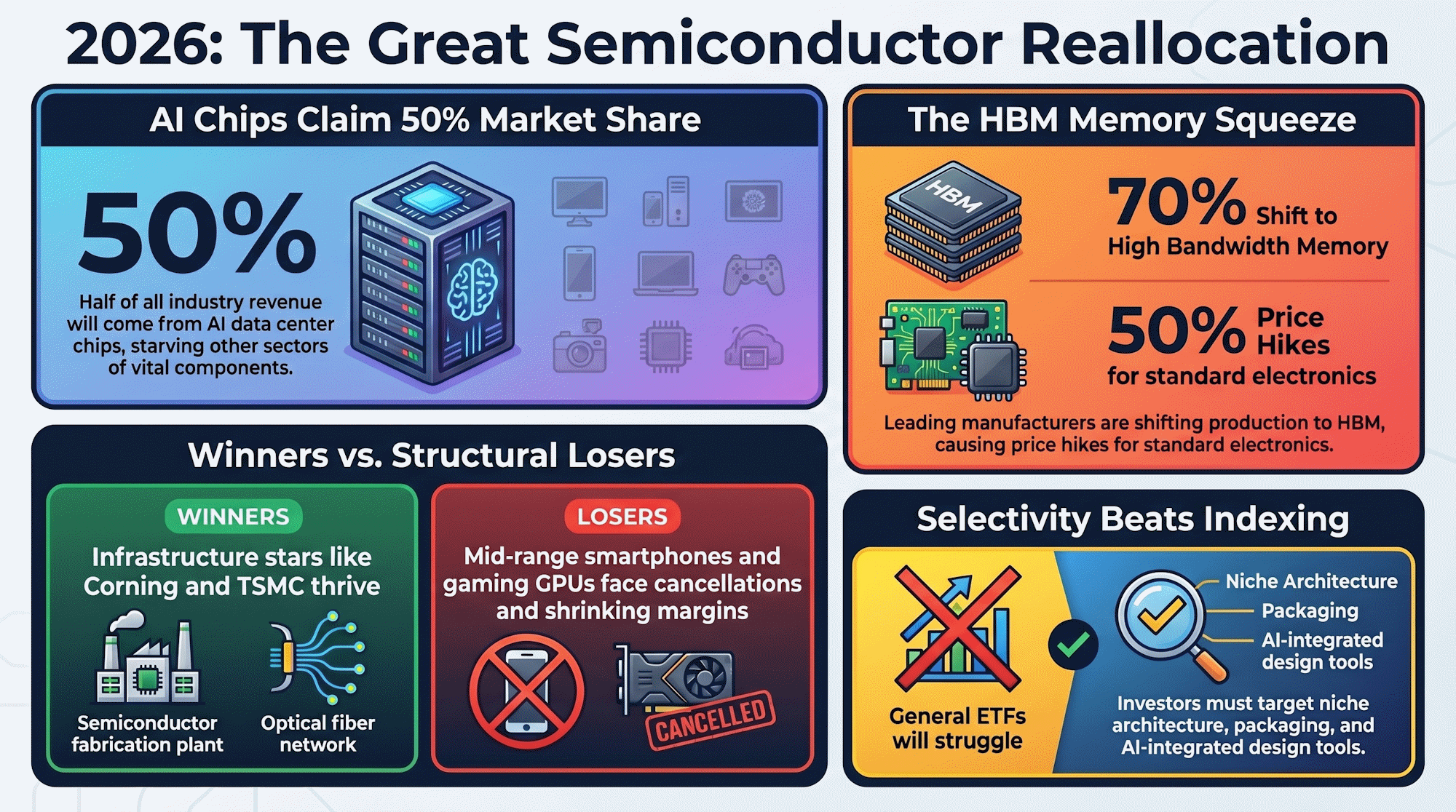
Look closer. Up to 50 percent of that revenue in 2026 is expected to come from a single segment – AI chips for data centers. A few years ago, this market didn't even exist at this scale. Now it's swallowing half the industry.
You remember Kostolany, right? He once said something along the lines of: At the stock market, anything is possible – even the opposite. That's exactly what's happening. While everyone is staring at "the semiconductor sector" as if it were one giant pot of soup, in reality only one little corner of it is boiling. The rest? Some of it is sitting on dry land.
The memory crisis – and why even Nvidia is taking hits
Now it gets interesting. The three big memory manufacturers – Samsung, SK Hynix and Micron – have completely sold out their HBM3E capacity for 2026. At prices roughly five times higher than standard GDDR7. Samsung has converted 70 percent of its production lines from DDR5 and GDDR over to High Bandwidth Memory.
What does that mean? IDC calls it a "potentially permanent strategic reallocation" of the world's wafer capacity. In plain English: Every wafer being produced today for an HBM stack on an Nvidia GPU is missing somewhere else. From your smartphone. From your SSD. From your next laptop.
And now the bombshell that won't make the evening news: Nvidia is releasing no new gaming graphics card in 2026 – for the first time in 30 years. The RTX 50 Super? Cancelled. The RTX 60 series? Pushed to 2028. Why? Because the business that built Nvidia is no longer profitable enough to justify manufacturing capacity.
Let that sink in for a second. The company that grew up on gaming is dropping its home market like a hot potato. Because the margins on AI chips are simply unbeatable. Counterpoint reports a 50 percent jump in memory prices in Q4 2025 alone. Deloitte expects another 50 percent by mid-2026.
If that doesn't show you what's happening here, I don't know what will.
The mental trap most investors are walking into right now
Here's where most investors get caught. They hear "AI boom" and blindly buy the semiconductor ETF. The SOXX, for example. Sounds reasonable, doesn't it? Diversified, broadly spread, can't go wrong.
Yeah. That's exactly where it gets tricky.
An ETF weights every company inside it – including the ones whose business model is breaking apart under the current structural shift. Smartphone makers in the lower segment? IDC's pessimistic scenario sees the market contracting by 5.2 percent in 2026 alone. TCL, Transsion, Realme – they're fighting on razor-thin margins because memory makes up 15 to 20 percent of their bill of materials.
Classic semiconductor manufacturers operating on mature process nodes? McKinsey only expects three percent annual growth here through 2030. While the high-end segment grows in double digits. This isn't a sector that's booming evenly. This is a sector splitting itself into winners and losers right now – and pretty brutally so.
Selection beats indexing. Period.
Where the really interesting stories are hiding
Now to the part that interests you: Who actually profits? And I'm not talking about Nvidia. You know Nvidia. Everyone has Nvidia. Nvidia is sitting on a valuation that's beyond good and evil.
The stories underneath are far more interesting. And here's my favorite example: Corning. Yes, the glass company. Famous for the iPhone display. Sounds boring? That's exactly the point. Corning supplies fiber-optic cables for AI data centers. Meta signed a six-billion-dollar deal in January 2026. The stock has put on as much as 300 percent in twelve months. The CEO believes the data-center fiber market could triple long-term.
Do you see what I mean? While everyone is hypnotized by the obvious names, the real winners are making their money in areas nobody is thinking about. Fiber optics. Memory specialists. Packaging providers. EDA tools that build AI directly into the chip-design process. Broadcom with its ASIC business for hyperscalers. TSMC, which can casually raise its sub-5nm prices by three to ten percent – simply because demand is so absurdly high.
This is Buffett logic in its purest form: Don't chase the gold miners. Look at who's selling them the shovels.
The second wave: AI is moving into your living room
And so you see the full picture – there's a second, quieter revolution happening at the same time. While everyone is staring at the data centers, AI is migrating into your laptop, your smartphone, your car.
The keyword is NPU – Neural Processing Unit. Apple's A19 Pro: 35 TOPS. AMD's Ryzen AI 300: 50 TOPS. Qualcomm's Snapdragon X Elite: 45 TOPS. Intel's roadmap shows NPUs at 74 TOPS by 2027. That's a fivefold increase from 2024. In three years.
Whoever dominates this architecture is locking in strategic market position for a decade. Comparable to what ARM was for smartphones. And yes, I know – the marketing promises are currently bigger than what the hardware can actually deliver. Running large language models locally on your machine? Not really, not yet. But it's coming. And when it comes, you want to be on the right side of the trade.
Geopolitics – the topic nobody is taking seriously enough
A quick word on geopolitics, because that's the wild card in this game. In late 2025, the Dutch state took control of the semiconductor manufacturer Nexperia. China responded with export controls. The automotive industry swallowed hard. The US government is balancing between export bans on Nvidia chips and selective exemptions for approved Chinese customers.
What this means for you: Semiconductors aren't just a tech topic anymore. They've become a sovereignty topic. Governments are pouring billions into domestic manufacturing. That creates structural tailwinds for regional champions – but also volatility you'll need to stomach.
My takeaway for you
Let me tell you what I think. 2026 isn't a normal semiconductor year. This is a generational moment. Comparable to the smartphone revolution at the end of the 2000s. To the internet in the mid-90s. To the industrial revolution – just compressed into time-lapse.
Three things to take away with you:
One: Be selective. Broad semiconductor ETFs won't capture this structural shift. Look at the business models one by one. Ask yourself: Who has a real moat, and who is just surfing the hype wave?
Two: Hunt in the second row. The most exciting price gains often aren't at the obvious names. Fiber optics, memory, packaging, EDA software – these are areas nobody has on their radar but that are growing structurally with the trend.
Three: Stay emotionally calm. Volatility will stay high. Q1 2026 already showed how quickly the sector can flip from euphoria into panic. But it's exactly in those phases that fortunes are built. Remember what Kostolany said: The stock market is a machine that transports money from the impatient to the patient.
If you think long-term, if you put in the work to filter out the right companies, and if you have the courage to buy more on weakness – then you have one of the best investment moments of your life sitting right in front of you. Period.
Remember that salesperson back in the electronics store? He was right. The only question is: This time, are you actually listening?
Not investment advice. Independently verify information and assumptions.