
AI Infrastructure: NVIDIA’s "Hidden Tax" and the Rebellion of the Giants
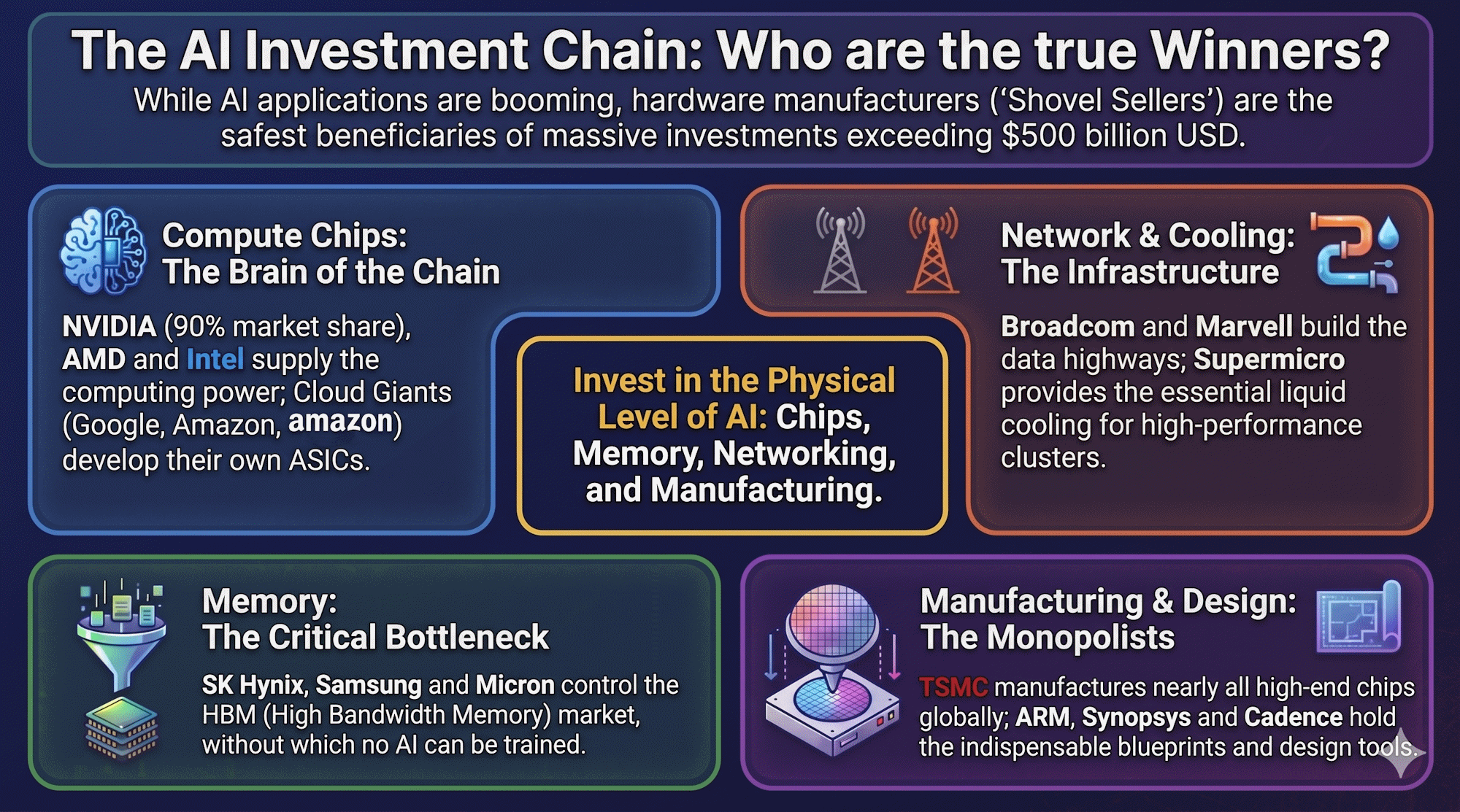
1. Introduction: The Most Expensive Race in History
We are in the midst of an unprecedented physical war of attrition that is pushing the boundaries of global infrastructure. The "Stargate" project—a mega-datacenter initiated by OpenAI, Softbank, and Oracle—illustrates these new dimensions: with a planned budget of $500 billion, a target of 400,000 high-end GPUs, and a power requirement of 1.2 gigawatts (comparable to a mid-sized city), this venture exceeds any previous IT investment.
"The budget for the Stargate project is roughly equivalent to the entire Gross Domestic Product (GDP) of Thailand."
This sum is merely the harbinger of a massive capital cycle. Cumulative investments by leading hyperscalers are expected to rise to $690 billion by 2026. As an analyst, the question arises: is this a speculative bubble or the necessary scaling of a new industrial base? The answer lies in the realization that computing power is the new hard currency of the global economy.
2. Takeaway 1: From Software Optimization to Physical Resource War
The era in which clever code alone decided market success is over. The new dogma is: "Intelligence is computable." Whoever controls the physical resources defines technological supremacy.
- The Giants' Prisoner's Dilemma: In the development of Artificial General Intelligence (AGI), second place is the first loser. A technical lag in GPT-5—which is estimated to require 10 to 100 times the computing power of GPT-4—would devalue business models in search and SaaS overnight.
- Compute as a Land Reserve: For cloud providers, GPU clusters are the "land reserves" of the 21st century. Those who fail to secure capacity today will not even have an "entry ticket" to the competition in two years.
- The New Role of the CPU: With the rise of "AI Agents" that make complex, multi-step decisions (e.g., travel bookings), the CPU is transforming from a mere data provider to a strategic orchestrator. This "value re-evaluation" is causing the CPU to regain importance in managing the complex logic chains behind GPU calculations.
3. Takeaway 2: The "NVIDIA Tax" and the Rebellion of the Cloud Giants
NVIDIA holds a de facto monopoly with a market share of over 90% in training chips. The "moat" here is not just the hardware, but the CUDA ecosystem—the "Windows of AI." Engineers avoid switching to competitors because porting code would cost months of debugging time. However, resistance is forming:
- The ASIC Counter-Attack: Google (TPU) and Microsoft (Maia) are betting heavily on application-specific integrated circuits (ASICs) that shed unnecessary overhead and halve the cost per inference for stable algorithms.
- NVIDIA’s Brilliant Counter-Move: NVIDIA is responding to the ASIC rebellion with an "Interconnect Tax." Through strategic investments in ASIC enablers like Marvell (the "hired guns" of the cloud giants), NVIDIA is forcing the "NVLink Fusion" architecture. The calculation: even if the cloud giants build their own chips, they should continue to use NVIDIA's proprietary network infrastructure. Whoever controls the connection collects the toll, regardless of the chip design.
4. Takeaway 3: The "Memory Wall"—Why HBM is the True Bottleneck
The fastest processor is useless if it remains in a "data famine." High Bandwidth Memory (HBM) is the critical bottleneck (the "Memory Wall"). While GPUs are the computational laborers, HBM acts as the highly specialized "bricklayer" delivering data with extreme bandwidth.
- IDM Manufacturing Barriers: Unlike logic chips, HBM cannot simply be outsourced to TSMC. It is a "craft" that requires decades of IDM (Integrated Device Manufacturer) experience.
- Strategic Scarcity: Only a trio (SK Hynix, Samsung, Micron) masters the extremely tight manufacturing windows. For competitors, especially from China, this means a technological lag of two to three generations that can hardly be closed by mere capital. HBM is currently the scarcest resource in the entire AI ecosystem.
5. Takeaway 4: The End of the Server—When the Rack Becomes a Single GPU
With the Blackwell architecture (NVL72), we are witnessing the transition from "Scale-Out" (many networked servers) to "Scale-Up" (an entire rack as a single unit).
- The 130 TB/s Revolution: While the scale-up limit in the H100 era was 8 GPUs, the NVL72 system makes 72 GPUs appear to the model like a single, giant chip. Bandwidth density reaches an astronomical 130 terabytes per second.
- Latency-Free Intra-Rack Communication: To eliminate the latencies of optical conversion, NVIDIA is returning to copper. The "NVLink Spine" in the rack consists of over 5,000 copper cables (weighing 35 kg). The goal is to create a "super-brain" rather than a loose federation of smaller units. The ratio of GPUs to 1.6T transceivers of 1:2 to 1:3 underscores the enormous networking effort.
6. Takeaway 5: Liquid Cooling is No Longer a Luxury, But a Matter of Survival
A single H100 node consumes 10 kWh—conventional air cooling has reached its physical limits at this power density. In a standard rack, only four servers could be operated without radical measures before the hardware suffers thermal collapse.
- Thermal Compression: Liquid cooling is the only solution to double the computational density per square meter. Elon Musk's xAI center demonstrates this impressively by integrating 64 H100 chips into a single, liquid-cooled rack.
"In the AI era, liquid cooling is much more than just cooling; it is the strategic compression of physical space and thus the decisive lever for the economic efficiency of the compute factory."
By eliminating massive fan systems and reducing the footprint, the immense construction costs for the physical shells of datacenters are drastically reduced.
7. Conclusion: Will We Ever Get Rid of the "Compute Tax"?
Currently, the "shovel sellers"—NVIDIA for logic, the HBM trio for memory, and specialists for thermal infrastructure—are the guaranteed beneficiaries. However, the market is facing a shift: while training dominates today, inference will determine volume in the future. Industry forecasts suggest that the share of ASICs in the inference market will rise from the current 10% to 40% by 2028.
The physical reality, however, remains the ultimate arbiter. We are observing a transformation from IT architecture toward heavy industry.
Closing Question: In the end, will the relentless physical limits of power grids and cooling capacities slow the pace of AI evolution more than human ingenuity?
Not investment advice. Independently verify information and assumptions.